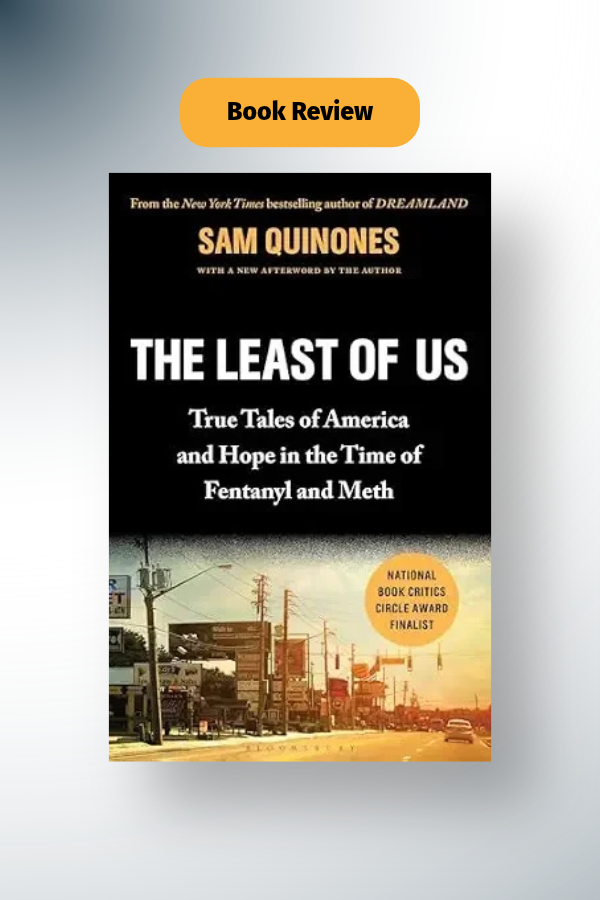
The Least of Us: True Tales of America and Hope in the Time of Fentanyl and Meth by Sam Quinones
What happens when some of the most dangerous drugs America has ever encountered collide with communities already struggling with isolation, poverty, mental illness, and a loss of connection?
In The Least of Us: True Tales of America and Hope in the Time of Fentanyl and Meth, journalist Sam Quinones explores the devastating transformation of America’s drug crisis and, importantly, the people and communities finding ways to respond.
Quinones, author of the acclaimed Dreamland, takes readers across the country to understand the emergence of synthetic fentanyl and new forms of methamphetamine and the profound consequences these drugs have had on individuals, families, neighborhoods, healthcare systems, and communities. His reporting is sobering. But The Least of Us is not ultimately a book about despair. It is a book about the possibility of recovery and the essential role that human connection plays in making recovery possible.
That makes it especially relevant to HomeAid.
Understanding a Complicated Intersection
Homelessness and addiction are often discussed together, sometimes in ways that oversimplify both.
It is important to recognize that substance use does not explain homelessness as a whole. People lose housing for many reasons, including the cost and availability of housing, poverty, job loss, domestic violence, health challenges, family instability, and other circumstances. At the same time, HomeAid’s service-provider partners regularly encounter individuals whose experience of homelessness is complicated by substance use disorders, mental health challenges, trauma, or a combination of these factors.
The Least of Us helps readers better understand one piece of that complicated picture.
Quinones examines how today’s synthetic drugs differ from earlier generations of illicit substances. Fentanyl is extraordinarily potent and inexpensive, while the methamphetamine supply has also changed dramatically. He explores the effects these drugs can have on individuals and communities and why traditional approaches to addiction may struggle to keep pace with a rapidly evolving crisis.
But Quinones also looks beyond the drugs themselves. He asks us to consider the environments in which addiction thrives.
Again and again, the book returns to isolation.
The Power of Community
One of the most compelling ideas in The Least of Us is that the opposite of addiction may not simply be sobriety; it may also be connection.
Quinones introduces readers to people who refuse to give up on their neighbors: families, healthcare workers, treatment professionals, people in recovery, law enforcement officers, volunteers, and community leaders. Their approaches differ, but many share an understanding that recovery rarely happens in isolation.
People need relationships. They need someone who believes change is possible. They need communities that provide accountability and encouragement. And they often need a safe and stable place from which recovery can begin.
This is where the book’s message intersects powerfully with HomeAid’s mission.
Why This Book Matters to HomeAid
At HomeAid, we help people experiencing or at risk of homelessness build new lives through construction, community engagement, and education.
Construction provides the physical environment, a safe, dignified place where someone can begin moving forward.
But our work has never been about buildings alone.
The housing and facilities HomeAid builds and renovates allow our nonprofit partners to provide counseling, healthcare, addiction recovery programs, workforce development, education, case management, childcare, and many other services. The building becomes the place where relationships can form and healing can begin.
In that sense, HomeAid helps build both places and connections.
Quinones’s reporting reinforces why those connections matter. A person struggling with addiction or homelessness may have experienced years of broken relationships, trauma, rejection, or isolation. A housing program cannot repair all of that overnight. But it can provide stability and create an environment where trusted relationships and supportive services can take root.
Seeing the Person, Not the Problem
Perhaps the greatest lesson of The Least of Us is contained in its title.
It challenges us to consider how we respond to people who are among the most vulnerable and marginalized in our communities.
It is easy to see addiction and homelessness from a distance and focus on behaviors, statistics, encampments, or public policy debates. It is much harder and much more important to see the individual person.
That does not mean ignoring personal responsibility or the consequences of destructive choices. Rather, it means recognizing that accountability and compassion do not have to be opposites. Recovery requires individuals to make difficult choices, but communities can create conditions that make those choices more possible.
For those involved with HomeAid, that is an important reminder. We don’t need to know every detail of someone’s journey to recognize their inherent dignity or believe that their story is not finished.
In Closing
The Least of Us is not an easy book, but it is an important one.
Sam Quinones provides a sobering look at the fentanyl and methamphetamine crisis while ultimately offering something our communities desperately need: hope grounded in action.
His reporting suggests that some of our strongest tools against addiction and despair are remarkably human: relationships, belonging, purpose, accountability, compassion, and community.
Those same ideas weave through HomeAid’s work.
Every HomeAid project begins with people coming together- builders, trade partners, donors, volunteers, service providers, and community leaders because we believe that people experiencing homelessness should not have to face their challenges alone.
The Least of Us reminds us why that matters. When isolation contributes to despair, connection can become part of the pathway back. And when communities choose to see, value, and invest in people who are struggling, hope has somewhere to take root.
Other Reviews