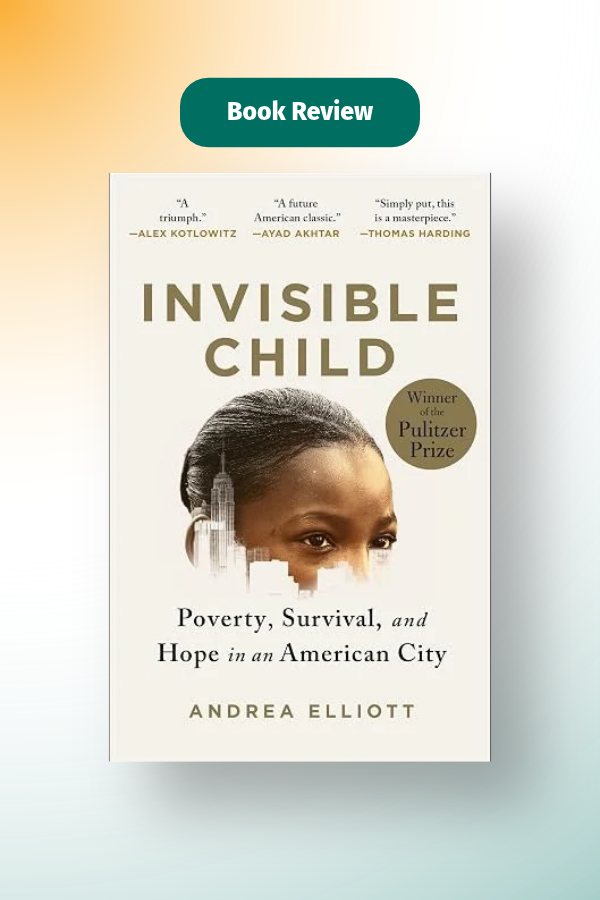
Invisible Child: Poverty, Survival, and Hope in an American City
What does homelessness look like through the eyes of a child?
In Invisible Child: Poverty, Survival & Hope in an American City, Pulitzer Prize-winning journalist Andrea Elliott provides a deeply personal answer to that question through the remarkable story of Dasani Coates, a young girl growing up amid poverty and homelessness in New York City.
Elliott spent eight years following Dasani and her family, beginning when Dasani was 11 years old and living with her parents and seven siblings in a single room in a Brooklyn homeless shelter. What emerges is far more than a story about one child. It is an extraordinary examination of family, poverty, housing instability, education, addiction, foster care, inequality, and the remarkable resilience of a young girl determined to protect the people she loves.
Elliott also reaches back through generations of Dasani's family, connecting their experiences to a much larger American story. The result is a book that asks readers to consider how history, housing, opportunity, public systems, and family circumstances can converge in the life of a child.
Winner of the 2022 Pulitzer Prize for General Nonfiction, Invisible Child succeeds because Elliott never allows the issues to overshadow the people. The statistics surrounding homelessness are important, but through Dasani we experience what those statistics actually mean: trying to succeed in school without a stable home, caring for younger siblings while still being a child yourself, navigating complicated social-service systems, and trying to imagine a different future while remaining fiercely connected to your family.
Seeing the Invisible
The title itself offers an important challenge.
Children experiencing homelessness can often be invisible to the communities around them. They attend school, ride buses, play with friends, and sit beside other children in classrooms while their classmates may have no idea that they spent the previous night in a shelter, motel, car, or temporary living arrangement.
Invisible Child asks us to see them.
Dasani is not presented simply as a "homeless child." She is intelligent, complicated, protective, determined, funny, angry, hopeful, and extraordinarily resilient. Homelessness is something she experiences; it is not the totality of who she is.
That distinction matters.
Why This Book Matters to HomeAid
At HomeAid, our mission is to help people experiencing or at risk of homelessness build new lives through construction, community engagement, and education.
Invisible Child provides a powerful reminder of why that work matters.
A safe, dignified place to live provides much more than protection from the elements. For a child, housing stability can mean having a consistent place to sleep, study, eat, and prepare for school. For parents, it can create the foundation from which they can pursue employment, address health challenges, care for their children, and begin planning beyond the next day or week.
Across the country, HomeAid partners with organizations serving families and children experiencing homelessness and housing instability. Through the expertise and generosity of the homebuilding industry, our affiliates build and renovate housing and facilities where families can find not only shelter, but also the services and support needed to move toward greater stability.
Elliott's reporting also reminds us that housing alone does not erase every challenge. Families may be navigating trauma, poverty, healthcare needs, addiction, employment challenges, education, childcare, and complicated public systems simultaneously. Effective responses to homelessness therefore require partnerships among housing providers, service organizations, schools, healthcare professionals, businesses, government, volunteers, and the broader community.
That collaborative approach is at the heart of HomeAid.
Beyond the Statistics
Perhaps the most important contribution of Invisible Child is that it makes homelessness personal.
It is easy to talk about homelessness through numbers: shelter beds, housing units, point-in-time counts, rents, incomes, and percentages. Those measurements help us understand the scope of the challenge, but they cannot fully communicate what losing a home means to a child.
Dasani's story reminds us that behind every number is a person. Behind many of those people is a family. And within those families are children whose experiences today can influence their opportunities for years to come.
The book also resists easy answers. There are no simple heroes and villains and no single intervention capable of solving every problem. Instead, Elliott shows the complexity of poverty and homelessness while preserving the dignity and agency of the people whose lives she documents.
In Closing
Invisible Child can be difficult to read at times, but it is an important book for anyone seeking a deeper understanding of homelessness in America.
Andrea Elliott challenges us to look beyond assumptions and statistics and see homelessness through the experience of one remarkable child and her family. In doing so, she reminds us that every child deserves more than survival. Every child deserves safety, stability, opportunity, dignity, and hope.
For the HomeAid community, Invisible Child reinforces an important truth behind our work: when we help create a safe and stable place for a family to call home, we aren't simply building housing. We are helping create the foundation from which a child and an entire family can imagine what comes next.
Other Reviews